 by
Lynn and
John Salmon
by
Lynn and
John Salmon
by
Lynn and
John Salmon
by
Lynn and
John SalmonWe got underway at about 9:30am motoring out of the harbor with John posted in the bow again to look out for unexpected coral heads. While at sea everyone will have assigned watches on the boat. The watches are set up with three day-shifts and four night-shifts with three groups of two people per watch. This means we will rotate our watch times around. The shift times are: 0800-1200, 1200-1600, 1600-2000, 2000-2300, 2300-0200, 0200-0500, 0500-800 ... John and I got the first watch from 1200-1600 and Frank went to sleep leaving us in charge. Yikes!
On watch we pay attention to the wind and adjust course depending on what it does. Every hour we write our heading, speed and distance covered (mechanical), speed over ground and true direction (from the GPS), and wind speed and direction, in the ships log. At my first turn at the helm, I did an unintentional 360 degree turn. A few hours later, Mike did another one. What a sorry crew on this fine vessel.
The boat responds to the rudder very, very slowly. This is not a sports car. When one turns the wheel, several seconds go by and nothing happens. Then several more seconds go by. At this point, you figure you must need to turn the wheel further. Then, all at once, the rudder "catches" and the ship turns rapidly. By now it's probably too late to straighten out in time to hit the course you were aiming for, and you oversteer. The system (ship plus helmsman) is severely underdamped. Add to that the fact that neither the terminology (upwind/downwind) nor the gages and dials (relative wind direction, compass) are second nature, so you have to actually think to understand what is being said, and how to accomplish it, and it's easy to see how things can get out of hand. Fortunately the winds are light, and the captain is easy-going and understanding, so it's not a big problem. Of course, there's always the autopilot, but even it has trouble when the winds are this light.
The wind is coming directly from Pitcairn and we make 4-5 knots, but not toward Pitcairn. By evening the wind died and we were running the motor. Our second watch from 11pm-2am was uneventful. No wind - just motoring along. Our time at sea is spent either on watch or trying to sleep.
We learn that staying dry is not easy on an extended yacht trip. The occasional splash comes over the cockpit and leaves the helmsman soaked even in mild weather. Even light winds and seas kick up enough spray to make it impossible to hang clothes out to dry. Inside, the cabin is always slightly humid, so things don't dry there either. This explains why the yachts that pulled into Rikitea's harbor looked like giant clotheslines as soon as they were securely anchored. One solution, at least in the tropics, is to wear as little as possible, and not worry about getting a little wet.
John and I had the morning 8-noon watch. It was very pleasant. We were under sail, but didn't go very fast (~5 knots at most). By dinner, however, the wind really picked up and by our 8pm-11pm watch we are really ripping along at 10-11 knots. Some bioluminescense lights up the froth coming up in our wake. The wind has now shifted and is perfectly directed so we head straight for Pitcairn on one tack.
It was exhilarating and a bit scary going so fast with the boat heeled over at a 30 degree angle and water pouring over the gunwales. Despite the increased winds (20-25 knots), the seas are fairly calm. Thus, there isn't a lot of pitching and rolling and the boat is going nearly maximum speed. If only it had a competent crew capable of trimming the sails, we would be going even faster. As it is, we have a couple of terrified helmsmen, a knowledgeable captain (sleeping) and only three crew really capable of doing any heavy winching (Mike, John and Del).
We watched black clouds on the horizon that corresponded to rain squalls visible on the radar. We tried to steer around them, but we were reluctant to change our heading by more than a few degrees, lest we need to adjust the sails or worse. A 360 degree turn in these conditions would be far more serious than earlier in the day. Luckily, we missed all but one squall and got only a little wet.
After our watch, sleeping in our bed was impossible as it didn't have a railing. Also, the stateroom is far from the center of the boat, so has the largest amplitude swings as the boat pitches over the waves. The biggest problem with sleeping, though is the fact that the boat is heeled way over (maybe 30 degrees) and even a small pitching action sends you a few inches "downhill" on every wave. It doesn't take long before you're on the floor. Lynn crawled into one of the upper bunks with a railing and John attempted a spiderman posture in the double bed, holding on with arms and legs spread-eagled over maximum area. He gave up after a while and found another bunk on the downhill side of the boat. Despite the difficulty in walking and sleeping, we are fortunate to have avoided sea sickness so far.
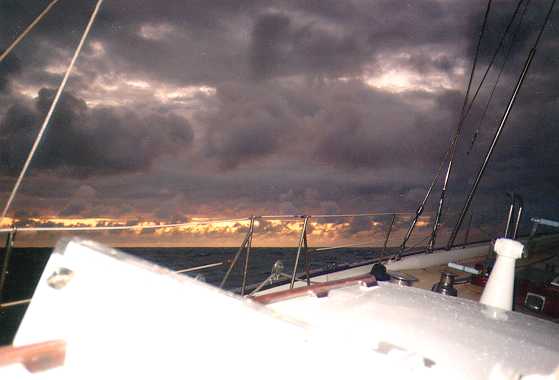
At about 4:00am I (John) awoke to a loud "BANG". A couple of minutes later Del was waking me up to tell me that I was needed on deck. The weather has gotten worse. We have run into a couple of squalls with winds gusting and changing direction rapidly. That wouldn't be so bad, but we just broke a "boom vang". Of course I had no idea how serious this is, except that Frank thinks it's serious enough to get another "able seaman" on deck. Sailors will know that the boom vang maintains downward tension on the main sail so that it keeps its shape in the wind. Apparently the shackle that holds it to the side of the boat failed, but we don't learn that until after it is removed and brought inside for inspection. It may simply have been improperly secured, or it may be that the part failed. Whatever the cause, we have a large block and tackle arrangement dangling off the side of the boat, and our main sail is flapping around with a new, and undesirable degree of freedom.
Del and Frank have the watch, but Frank wants a third person on deck while he does the repair. First, we have to haul in the main, which requires cranking the large winch that adjusts the main sheet. Then, with the main close enough to reach, Frank undoes the vang altogether and takes it below for repairs. During this time, I have the helm with instructions to keep us close to the wind. Fortunately, the wind doesn't shift much, and my "skills" as a helmsman are not put to the test. Frank assembles another vang from stock parts (shackles, block, tackle, etc.) and comes back on deck to re-install it.
The weather has turned pretty nasty at this point (at least for a non-sailor), with driving rain and gusty winds. I now understand why my sailing friends strongly recommended good foul-weather gear for the trip. Despite the fact that we are in the tropics, the combination of wind and spray and mid-winter evening temperatures in the 70s makes it worth wearing a a good rain jacket. Also, I am learning the considerable benefits of good deck shoes. During dry, placid conditions we've all been going around barefoot, but things get pretty slippery on deck and I find that the deck shoes I purchased just before leaving home have a much better grip than bare feet.
Frank has to reach far out over the side to complete the attachment of the new boom vang, and he remarks that it was while attaching a boom vang that he once actually fell overboard. A repeat performance would very possibly be fatal tonight. Even the quickest possible deployment of the life-saving gear (with strobe, radio beacons, and reflectorized flotation devices) couldn't possibly hit the water until the boat was hundreds of yards from where the victim went overboard. For this reason, everyone wears a harness and secures a connection to the lifelines that run the length of the deck whenever they are outside after dark. Although this makes moving around more awkward, it is an absolutely necessary safety consideration.
After the repair, Frank goes back to sleep, but I stay up since I will have the watch in a few minutes.
It's our turn for the 5am-8am watch. This one was hard. It is raining and we mostly watch from inside the cabin. The autopilot is steering and the boat is really screaming along. John goes out to check the instruments in the cockpit (compass heading and speed) frequently, and every indication is that we are in perfect yachting conditions: relatively calm seas, 20kt wind on the beam, boat ripping along at 10-11kts, but we don't really know and it's dark and everyone's asleep but us. Better sailors would probably have trimmed the sails for even more speed, but we are going fast enough thank you.
After 48 hours sailing our bodies are quite exhausted. I think the hardest part was the angle of the boat and the difficulty of moving around. Everything was a challenge. Changing clothes, eating, sleeping, all required hanging on to something. Every time John moves around he acquires another bruise: an elbow bangs on a winch drum, or a knee slams into a bulkhead, or an ankle twists on a slippery portion of decking. A couple of them are quite spectacular looking. None are serious injuries, but the accumulation of them is enough to make him want to remain stationary.
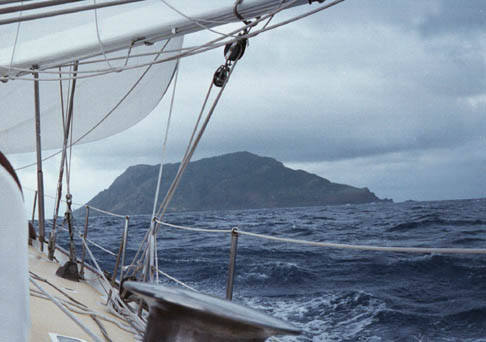
There's great news this morning: with our increased speed last night we should reach Pitcairn by noon. At about 9am we see it on the horizon. We've been in radio contact with the Pitcairners since we were in Mangareva, and they ask us to sail past the north of the island so they can get a good look at KialoaII under sail. We approach the island from the west and then circle around the north of the island, past Bounty Bay and on to the other side of the island where Frank anchored the boat in the lee.
Thus, we get a good look at the west, north and southeast sides of the island. The western flank of the island looks like the wind-sculpted features of Ayers rock. It's all carved up into huge shallow caves and smaller rounded nooks and crannies. As we pass to the north we see "Fletcher's Cave", and a few of the houses in Adamstown. The island is rugged and incredibly picturesque, but there's so much spray that we don't risk our new camera. The wide-angle point-and-shoot isn't really the right tool for the job, but it will have to do.
When we tack back to the southwest there's a major mis-communication on deck and it takes a long time to pull in the jib. I am working the two-man, two-crank grinders by myself. It's designed to let two people apply all their upper-body strength to the grinder with a large moment arm (the handles are maybe 16 inches long) and then gears the movement down so they have an additional mechanical advantage of another factor of eight or more. Even so, part of the mis-communication is that I don't get any help on the grinder, and Frank keeps wanting it tighter and tighter. Eventually I get it in with a liberal helping of grunts and tarzan-style shouts. The jib sheet is TIGHT.
Everyone packs up and is ready to leave when Frank tells us that we have a lot more to do before we can go and all the crap on deck will just be in the way. Some stuff gets put below, but everyone's tired and nobody knows what they should be doing to move things along, so our preparations go slowly. We rather inexpertly take down the jib and main sails. Then we assemble the dinghy and launch it using the main halyard to hoist it up over the safety lines and then lower it into the water. The seas are too rough for the Pitcairn longboat to tie up alongside the KialoaII, so the procedure for getting to Pitcairn is to first transfer from Kialoa II to the dinghy, and then from the dinghy into the longboat. Frank stayed on the KialoaII and was joined by Adrian.
The railing on the longboat is high out of the water, and one first has to grab onto an old truck tire used as a fender, and then clamber into the longboat. Fortunately, as soon as one is clinging to the fender, strong arms reach down and help with the final steps. Quite a few people came out on the longboat to meet us. Dave and Jay are Pitcairn natives, plus Del's husband Rick, Daphne's daughter-in-law, Lorraine, two of the Robben children, Dalreen and Adrian, plus a couple of island visitors, Myron and Rob. Myron is an astrologer from Israel, and Rob is an Englishman who seems to be working his way around the world in no particular hurry. There are a heap of other visitors currently on the island, mostly from the Rat Patrol (aka Rat Pile, Rat Boys, Rat Crew ...).
Arriving at the dock, we are met by several more islanders including Meralda, the police chief and immigration officer. She tells us to come find her at her house to get our passports stamped. All visitors to Pitcairn stay at a private home and take their meals there. There are no hotels or restaurants. At the time of our visit, the island has a population of about 35 people - many of whom are not permanent residents (e.g., the pastor John Chan and his wife Yvonne who is the island medical officer). We learn that we'll be staying with Dobrey Christian, Mike will be staying with Dave and Lea Brown, and Cynthia will join her children at the home of Jay and Carol Warren.
We have our first encounter with Pitcairn transportation when we get a ride on a Honda four-wheel drive all-terrain-vehicle (ATV). These are the primary means of transportation on the island. They have huge, inflated tires that get traction (usually) even in Pitcairn's famous mud. Before the arrival of the ATVs all access from Bounty Bay to the inhabited parts to Pitcairn was on foot up the steep and slippery Hill of Difficulty.
We stay with Dobrey Christian in Steve and Olive Christian's house. Steve is Dobrey's son, but he and Olive are away in New Zealand. Dobrey immediately fed us some fresh fruit and tea upon our arrival. We wolfed it down like starved rats. Dalreen then came by and we went for a walk. It has rained recently and the roads on Pitcairn have turned to muck. The mud is thick and slippery and progress is slow. We had read about the "famous Pitcairn mud" in several visitor's accounts, but we were unsure exactly what to expect. The stuff is slippery and sticky. Shoes quickly develop a couple of inches of gooey mud on all sides, and walking on the steep trails is extremely difficult. Dalreen runs ahead at one point and falls on her butt.
The mud rapidly diffuses up one's legs, and after a hundred yards of walking, long pants are a mess. Those wearing shorts look like they've been wading up to mid-calf in a mud bath. The local custom is to remove one's shoes before entering a house, in a desperate attempt to keep some of the mud outside. This has only a limited effect, and much time is spent cleaning up. The children approach the matter somewhat differently - they go barefoot. John tries this and finds that the mud doesn't form quite such a large encrustation around bare feet. Nevertheless, footing is still difficult, and we walk extremely carefully, in constant fear of spraining an ankle.
With Dalreen as our guide, we stopped at Carol and Jay's house and were invited in for tea. This is our first introduction to an integral part of island life. The locals are constantly popping in for a quick visit and a "cuppa". It makes for an incredibly friendly and relaxed atmosphere. We collected Mike who is staying at Dave Brown's house. Dave also has a slightly more exotic guest - a frigate bird lives on a perch outside his front door. Frigate birds are very large, and very ugly.
With Mike along, we toured "downtown" Adamstown, which is just a small square with a few public buildings. Although Pitcairn only has between 30 and 40 permanent residents now, it has had up to about 200 in the past, so there are public buildings to support a somewhat larger community. After the recent rain, the afternoon sun puts everything in a beautiful light. I am particularly taken by the small church, which is just beautifully proportioned, with clean simple lines. It's also spotlessly clean, despite the mud outside, so we remove our shoes before venturing inside. Inside, we find the "Bounty Bible", originally kept in Lt. Bligh's cabin. It's the bible John Adams used to teach the second generation Pitcairners both reading and religion. It's kept in a glass case at the front of the church.
We leave Adamstown and head in the general direction of Fletcher Christian's
cave. Along the way, we meet Graham Wragg of the Te Manu.
He points out a number of interesting
plants along the way.
One, in particular, is known as "indian buckshot" because of its perfectly
round, and extremely hard seeds.
We end up at the hostel where Graham and the Rat Pile are staying.
The Rat Pile
are a larger-than-life collection of characters
who would be at home on the pages of an underground superhero
comic.
They are a group of itinerant biologist/exterminators
who travel from island to island around the world, killing rodents.
Somebody has to do it. Now I know who.
Brian Bell runs Wildlife Management International, Ltd -
known to the Pitcairners
as the Rat Pile, or the Rat Boys, or the Rat Pack.
His son, Dave, and daughter, Bizz, are part
of the crew. Dave makes quite an impression: he sports long blond
dreadlocks, and is often seen shirtless and
heavily armed. Another young guy named Chazz (Peter Marriott)
is wielding a large machete.
Keith Dyett is a Pitcairn native whose parents left the island
when he was young. He is returning, after a long absence.
Keith is known as "crocodile man" - somebody says he
wrestles alligators, but it's hard to tell where
the facts end and the tall tales start. In addition to being an
alligator wrestler of mythic dimension, he's also a gentleman and a scholar.
The whole gang sailed to Pitcairn on the little boat Te Manu
owned by Graham Wragg and Ed Saul.
Ed and his wife
Maddie are a couple of expat New Zealanders who now live on Raratonga
in the Cook islands. When not saving endangered species, and
exterminating vermin, they enjoy swimming with sharks, and
natural foods.
Ed is slowly buying out Graham's interest in the Te Manu,
and may well own it by the time you read this.
Graham has a PhD in zoology and did his PhD work on
the fossil birds of Henderson, so he is quite surprised that some people
have come half way around the world with the main purpose of visiting
Henderson.
We stay for a cuppa, and don't try to explain why it is that we call
hot-chocolate "Milodon" - it's a long story but here's a
picture!. We chat about
islands, and rats and World Heritage listings, etc. The Rat Pile will be
moving on to Ascension island after Pitcairn, and some islands north
of Scotland may be next on the agenda.
Brian has some insider
info on upcoming World Heritage listings, and he correctly predicts
that Macquarie and Heard Islands will be listed in 1997. Gough Island,
another antarctic island was listed last year. Now that we will soon
(we hope) visit Henderson, the World Heritage Committee has upped the
ante, and listed a number of places that are both inaccessible and
cold.
Around 5:30pm the radio crackles and we don't make out what is said,
but a couple of minutes later, two ATV's roar up and announce that they
are our transportation back to dinner. Dobrey had sent out a call for
us, and the ATV drivers just decided it would be neighborly to give us
a lift. This is the kind of unselfish hospitality that Pitcairn is
rightly famous for.
Dobrey cooked up enough to feed
10 people and we feasted on corned beef, fish and fresh garden produce.
The fishballs were delicious, as were the freshly picked wild beans.
When we had eaten all we could she brought out huge heaping bowls of
ice cream for dessert.
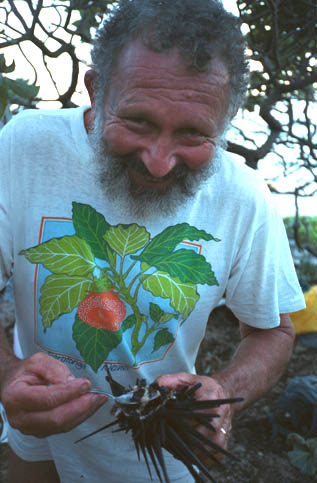 [Ed Saul serving raw sex organs of a sea urchin]
(to be continued - go to part 3)