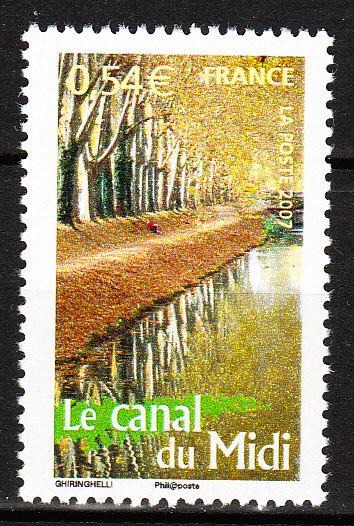
Jurisdiction of Saint-Emilion
(44.83 N 0.07 W)
The area is an exceptional landscape devoted entirely to
wine-growing, with many fine historic monuments in its towns and villages.
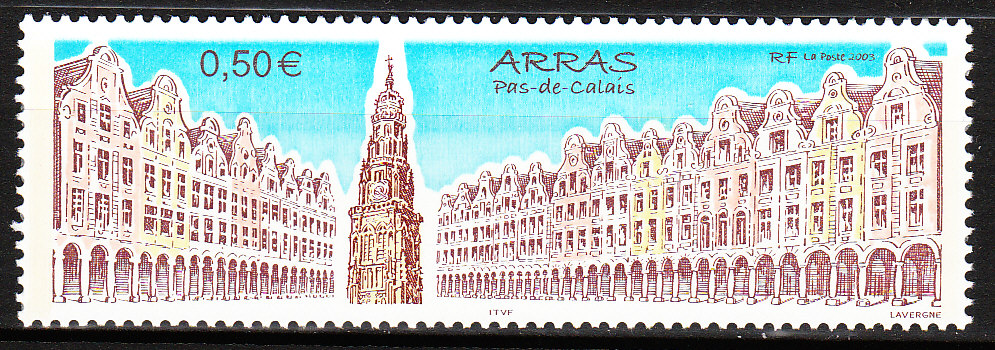
Belfries of Belgium and France
The 32 belfries in Flanders and Wallonia in Belgium
are imposing bell-towers of medieval origin, generally
attached to the town hall and occasionally to a church.
In addition to
their outstanding artistic value, the belfries are potent symbols of
the transition from feudalism to a mercantile urban society.
The site was extended to inclued 23
belfries in the north of France plus the belfry of Gembloux in Belgium in 2005.
The site includes
six marine clusters that represent the main diversity of coral reefs
and associated ecosystems in the French Pacific Ocean archipelago of
New Caledonia.
Joint listing with Austria, France, Germany, Italy, Slovenia, and Switzerland.
This property includes 111 small individual sites with the
remains of prehistoric pile-dwelling (or stilt house) settlements in
and around the Alps built from around 5000 to 500 B.C.
Villages and substantial stone farmhouses on deep terraces of the
Causses reflect the organization of large abbeys from the 11th
century. Mont Lozere, inside the property, is one of the last places
where summer transhumance is still practiced.
Architectural Work of Le Corbusier
Multiple sites in:
Argentina, Belgium, France, Germany, India, Japan, and Switzerland
(multiple sites)
Chosen from the work of Le Corbusier, the 17 sites comprising this
transnational serial property are spread over seven countries and are
a testimonial to the invention of a new architectural language that
made a break with the past. They were built over a period of a
half-century, in the course of what Le Corbusier described as "patient
research".
Taputapuatea
(-16.836 S -151.358 W) --
Located on Ra'iatea Island in French Polynesia,
Taputapuatea is a ceremonial and funerary center or marae complex.
This 67 million ha area comprises the largest of the rare
emerged land masses in the southern Indian Ocean: the Crozet
Archipelago, the Kerguelen Islands, Saint-Paul and Amsterdam Islands
as well as 60 small sub-Antarctic islands. It supports
one of the highest concentrations of birds and marine mammals in the
world including the largest population of King Penguins
and Yellow-nosed albatrosses in the world.
Considered a masterpiece of maritime signally built
in the 16th and 17th centuries.
The Lighthouse of Cordouan is on a shallow rocky
plateau at the mouth of the Gironde esturary in the Atlantic Ocean.
This joint listing comprises 11 towns, located in seven European countries.
All of these towns
developed around natural mineral water springs.
Vichy
Ancient and Primeval Beech Forests of the Carpathians
(
multiple locations)
For more links see Joint listing with Slovakia.
Joint listing with
Albania, Austria, Belgium, Bosnia and Herzegovina, Bulgaria, Croatia,
Czechia, France, Germany, Italy, Macedonia, Poland, Romania,
Slovakia, Slovenia, Spain,
Switzerland, and Ukraine.
These are the largest remaining virgin forests of the European
beech (Fagus sylvatica). They also hold the largest and tallest
beech specimens in the world.
This site originally consisted of ten separate components along an 185 km axis
from the Rakhiv Mountains and the Chornohirskyi Range in the Ukraine,
west along the Polonynian Ridge, to the Bukovske Vrchy and
Vihorlat Mountains in Slovakia.
The listing was extended in 2011 to include 5 Ancient Beech forests in Germany,
further extended in 2017 to include more forests in 10 countries, and further
extended in 2021.
Nice, winter resort town of the Riviera
(43.7017 N 7.272 E)
Mount Pelee and the Pitons of Martinique
(14.8233 N -61.1758 W) --
satellite view
Maison Carree of Nimes
(43.8382 N 4.3561 E) --
satellite view
Funerary and memory sites of the First World War
Joint listing with Belgium
Te Henua Enata - The Marquesas Islands
(-7.9699 S -140.646 W) --
satellite view
Megaliths of Carnac and of the shores of Morbihan
(47.616111 N -3.087222 W)
Back to the
World Heritage List
Lynn Salmon <>{
Last updated: July 23, 2025